
Putting Up a Sign on a Rented Shop in Nairobi: Landlord, County and Fees

On a rented shop in Nairobi, two parties get a say before your sign goes up: the landlord who owns the wall, and the county that licenses what faces the street. Skip either and the sign can come down, sometimes with a penalty attached. Both conversations are short if you have them before the sign is made, not after.
The short answer
Get the landlord's consent in writing, covering size, position, fixing and what happens when you leave. Then budget for Nairobi City County's signage charges. Under the county's Finance Act 2023, a sign fixed on a wall or canopy carries a one-off KSh 1,500 application fee plus an annual charge per square metre.
Key takeaways
- The landlord owns the wall, so get written consent before anything is drilled.
- The county charges by size: a one-off application fee, then a yearly charge per square metre of sign.
- Temporary items are charged too: teardrop flags and pavement roll-ups are listed per fortnight.
- Agree the exit now: who removes the sign and makes good the wall when the lease ends.
What your landlord will usually want to see
Most landlords are not against signs. They are against holes in the wrong place, signs that clash with the building, and a mess left when a tenant moves out. Bring them a mock-up and these answers, and consent is usually quick.
- Size and position: the exact panel, marked on a photograph of the frontage.
- Fixing method: how many fixings, into what, and whether a backing frame spreads the load.
- Power: for a lit sign, where the cable runs and which meter it uses.
- Building rules: some plazas and malls set a standard sign size, colour band or lettering height for every unit.
- Removal: who takes the sign down at the end of the lease and who repairs the wall.
The costly mistake Ordering the sign first and asking the landlord second. If the plaza has a standard fascia size or the landlord refuses fixings into new cladding, the sign you paid for may not fit the space you are allowed. A five-minute approval before production saves a remake.
What Nairobi County charges for a shop sign
The county sets its signage charges in law. The Nairobi City County Finance Act, 2023 amended the "Outdoor Advertisement and Signage" schedule, and lists, among others, these charges:
| Item | How it is charged | Charge listed |
|---|---|---|
| Signboard on a wall or canopy, or hanging under a canopy | Application fee, one-off | KSh 1,500 |
| Illuminated sign, first square metre or less | Per year | KSh 2,800 |
| Additional sign area | Per square metre, per year | KSh 1,500 |
| Wall or window branding | First 10 m², per year | KSh 11,000 |
| Promotional flags and teardrops | Each, per fortnight | KSh 2,000 |
| Pavement signboard or roll-up banner | Each, per fortnight | KSh 14,000 |
Two things follow from this. First, sign size has a running cost as well as a making cost, so a sign sized to be read rather than to fill the whole wall saves money every year. Second, temporary street items are not free. A roll-up left on the pavement every day is charged at a far higher rate per square metre than a sign fixed to your own frontage. Charges can change, so confirm the current figure with the county before you apply.
Choosing a sign that fits the rules and the budget
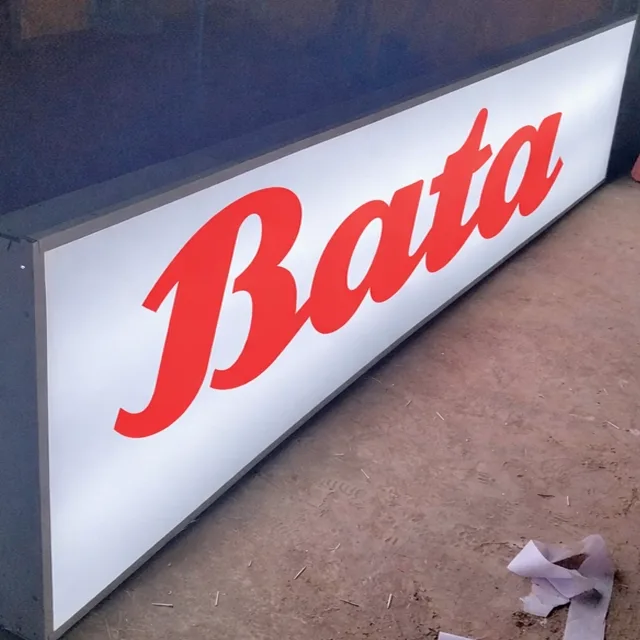
Once you know the space you are allowed, the material and the lighting decide the rest. Short lease? A framed flex board you can reprint is often the sensible spend, and it costs a fraction of a fixed sign. On a long lease, a weather-proof ACP business signboard or an acrylic-faced light box lasts the term. If the building allows only lettering, illuminated letters keep working after dark when a plain sign disappears. Materials compared: acrylic, ACP or flex.
- Photograph the frontage and measure the space the landlord will allow.
- Ask us for a mock-up on the photo, with sizes and the fixing method.
- Get the landlord's written yes on that mock-up, including removal at the end of the lease.
- Apply to the county and keep the receipt with your business permit papers.
- Install, then photograph the finished sign for your records and the landlord's.
A sign earns trust before anyone walks in Customers judge a business by its frontage in seconds, which is why the sign deserves a proper share of a new shop's budget. We explain why in how great signage builds customer trust.
Frequently Asked Questions
A landlord says yes faster to a picture than to a description. Share a photo of the frontage and the space you are allowed, and the sign comes back drawn onto it, ready to show.
Sources: Nairobi City County Assembly, The Nairobi City County Finance Act, 2023, amendments to the schedule "Outdoor Advertisement and Signage" (read 14 October 2026). County charges change; confirm current figures with Nairobi City County. This article is practical guidance, not legal advice.
Products in This Guide


Continue Reading


Comments are temporarily unavailable. Please check back soon.
Ready to Make Your Business Impossible to Miss?
From 3D signs to light boxes, we design, print and install signage that pulls customers in — across Nairobi and beyond.
Chat on WhatsApp
Join the Conversation