
Fire Safety Signs in a Kenyan Workplace: What the Law Asks For

When the alarm goes, nobody in the building reads the fire policy. They look for a sign. The fire exit that is clearly marked gets used; the one behind a stack of cartons with a faded paper sticker does not. Kenya's Occupational Safety and Health Act is specific about what a workplace must mark, and most of it comes down to signs that are easy to see in a hurry.
The short answer
Under the Occupational Safety and Health Act, emergency exits must be marked by a notice in red letters of an adequate size, firefighting equipment must be conspicuously displayed and unobstructed, gangways must be marked on workroom floors, and a clear, bold no-smoking notice is required wherever flammable substances are kept or used.
Key takeaways
- Emergency exits need red-lettered notices of an adequate size, under section 81(7).
- Extinguishers must be visible and reachable, not hidden in a cupboard or behind stock.
- Mark the floor: gangways keep exits and extinguisher points clear.
- Paper signs are not durable signs. Use materials that survive sun, cleaning and years.
What the Act asks every workplace to mark
| Section | What it requires | What that means in signs |
|---|---|---|
| 81(7) | Exits used for escape in a fire, other than the everyday exits, distinctively and conspicuously marked by a notice printed in red letters of an adequate size | A clear red fire exit notice on every escape door and window |
| 81(1)(a) | Means of extinguishing fire provided, maintained, conspicuously displayed and free from obstruction | Visible fire points, with a marked panel or cabinet |
| 81(8) | Gangways marked on the floor of every workroom, keeping extinguisher points and exits clear | Floor marking tape or paint along walkways |
| 78(5) | A clear and bold no-smoking notice where explosive or highly flammable substances are made, used or stored | No-smoking signs at stores, workshops and fuel points |
| 82 | Evacuation procedures designed and tested at regular intervals | Routes and assembly points people can follow during a drill |
That is the Act as published on Kenya Law. Your building may have more specific obligations under the rules made under it, and a fire safety audit will tell you exactly what applies to your premises.
The costly mistake Printing fire signs on paper and taping them up. Within a season they curl, fade or are cleaned off, and the exit that was marked last year is unmarked today. Safety signs belong on rigid, fade-resistant material that outlives the inspection.
Fire points: protect the extinguisher
An extinguisher bolted to an outside wall in Nairobi weather will be seized, faded or missing when it is finally needed. A cabinet solves all three problems. Our fire extinguisher cabinets are steel, welded and powder-coated in signal red, with a sloped lid that sheds rain and the fire-point marking applied as UV-stable printed vinyl rather than a paper label. They are built to the extinguisher size, 4.5 kg, 9 kg or a pair, and sites usually standardise every fire point in one batch.
Routes: signs people can follow under stress
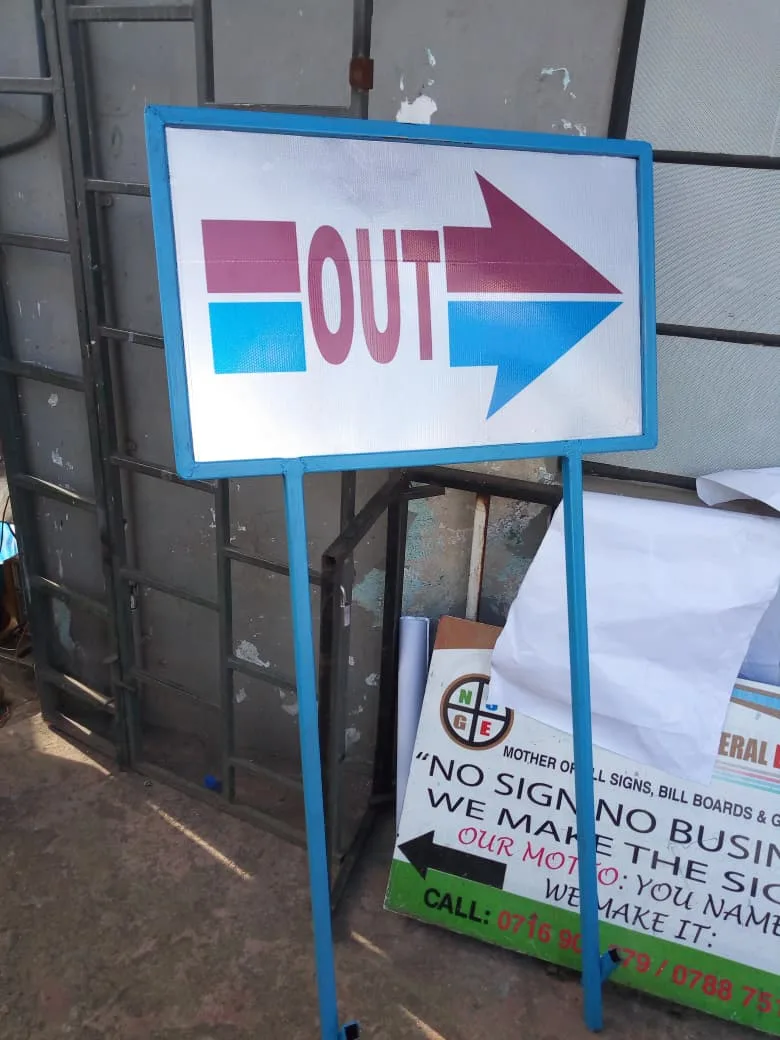
An escape route is a wayfinding problem with a deadline. Use one typeface, one arrow style and one colour logic from the work area to the assembly point, so people follow the pattern without thinking. Our wayfinding and directional signs are built as a system for exactly this reason, on aluminium composite outdoors and engraved acrylic indoors. On sites with vehicles, standard-shape reflective site and traffic signs mark speed limits, no-entry zones and the assembly point for drivers.
- Walk the building with the floor plan. Mark every escape door, window, extinguisher and store of flammable material.
- List the signs by location, not by type. "Store room door: no smoking" is easier to install correctly than "12 no-smoking signs".
- Choose the material for the place: outdoors and wet areas need aluminium or UV-stable vinyl; indoors, rigid acrylic or PVC.
- Mark the floor along gangways to the exits and fire points.
- Run the drill, then fix any sign that people walked past.
In a rented building Agree with the landlord who signs common areas and who signs your unit, so nothing is missed between the two. Landlord conversations about signs are covered in putting up a sign on a rented shop, and why low-cost materials cost more over time in the hidden cost of cheap signage.
Frequently Asked Questions
A floor plan, or even a few phone photos of the site, is enough to draw up a sign schedule, location by location. That schedule comes before any quote.
Sources: Occupational Safety and Health Act, 2007, Kenya Law, sections 78, 81 and 82 (read 14 October 2026). This is general information, not legal advice; a fire safety audit will confirm what applies to your premises.
Products in This Guide


Continue Reading



Comments are temporarily unavailable. Please check back soon.
Ready to Make Your Business Impossible to Miss?
From 3D signs to light boxes, we design, print and install signage that pulls customers in — across Nairobi and beyond.
Chat on WhatsApp
Join the Conversation