
Bulk Print Runs: Where the Price Per Piece Actually Drops, and Why

Ask for 500 brochures and then for 1,000, and the second quote is rarely double the first. Sometimes it is barely more. That is not a sales trick. Most of the cost of a print job is spent before the first good sheet comes off the press, and once that is paid, extra copies are mostly paper and ink.
The short answer
Every print job carries a fixed cost (artwork, proofing, plates or set-up, and the sheets wasted getting colour right) plus a cost per piece. The fixed part is shared across the run, so the price per piece falls quickly as quantity rises, then levels off. Order to just past the point where it levels off, not far beyond it.
Key takeaways
- The set-up is the same for 1,000 or 5,000, which is why brochures get much cheaper per piece above 5,000.
- Same artwork, several sizes, one order costs less than buying posters, flyers and banners separately.
- Compare quotes on the same basis: same quantity, stock, finish, and VAT shown the same way.
- Do not over-order to chase a low unit price. A box of out-of-date flyers costs more than a reprint.
What you are actually paying for
Split any print quote into two parts and it stops being mysterious.
- Fixed costs: preparing the artwork, the proof you approve, making plates or setting up the press, and the sheets run through to get colour and position right. These cost the same whatever the quantity.
- Running costs: paper, ink, press time, cutting, folding and packing. These grow with every copy.
Spread the fixed cost over 500 copies and each one carries a big share. Spread it over 5,000 and the share is a tenth of that. The running cost per piece barely changes, so the total price per piece falls steeply at first and then flattens.
Round numbers, to show the shape Imagine a job with KSh 10,000 of set-up and KSh 10 a piece to run. At 500 copies each piece costs KSh 30. At 1,000 it is KSh 20. At 5,000 it is KSh 12. Going from 500 to 1,000 saves a third per piece; going from 5,000 to 10,000 saves only one more shilling. These are illustrative numbers, not a quote.
Where the price drops on common jobs
These are the minimums and the points where our own prices change most, taken from our published price list.
| Product | Minimum | From | Where the price per piece drops |
|---|---|---|---|
| Brochures | 1,000 | KSh 25 each | Sharply above 5,000, because the press set-up is the same either way |
| Flyers | 500 | KSh 30 each | With volume, and lowest when ordered with the matching posters |
| Business cards | 500 | KSh 30 each | At 500 the price per card is already small; double-sided costs little more |
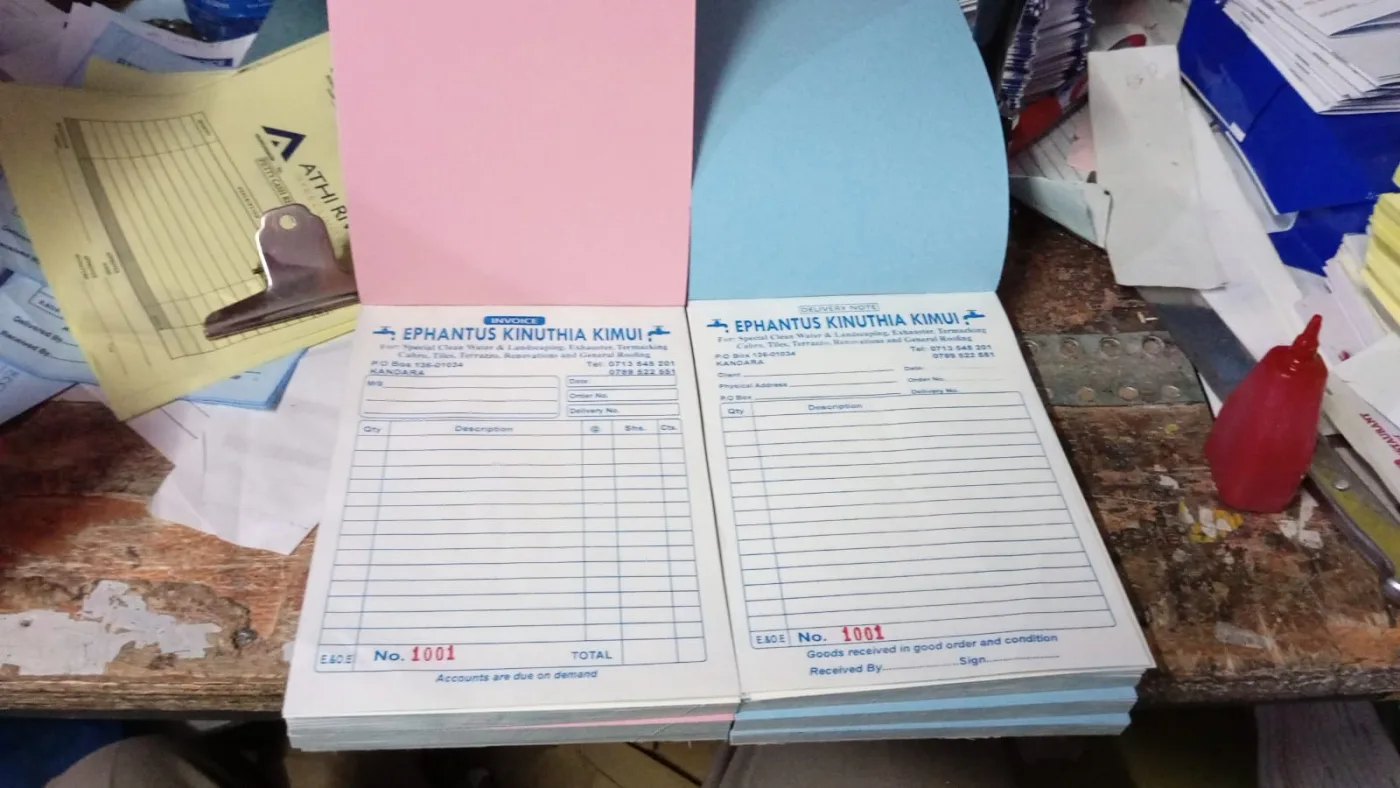
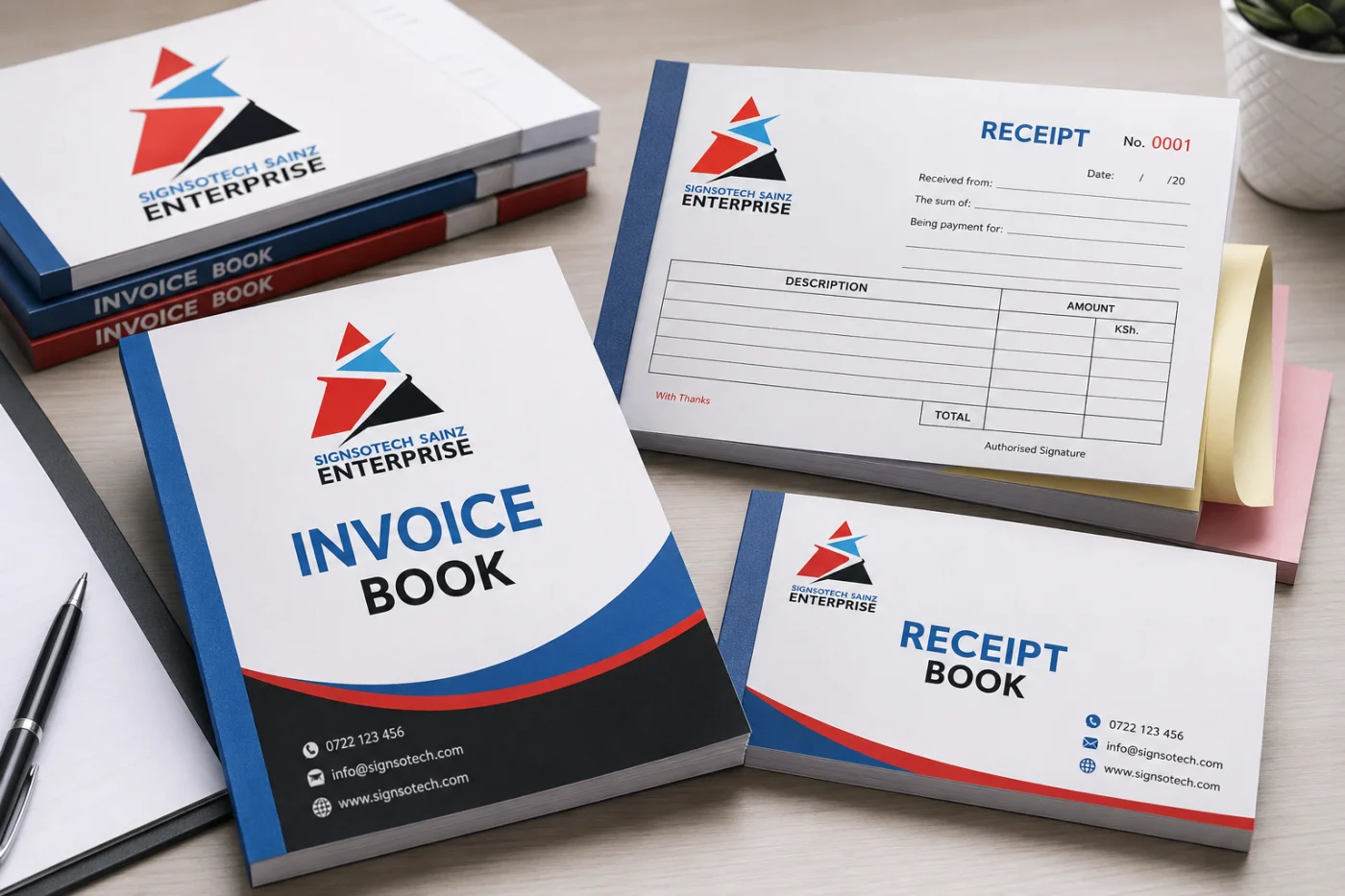
| Receipt books | 10 books | KSh 350 a book | Steeply from 50 books |
For brochures, the jump to 5,000 is worth it only if you will hand out 5,000 before the content changes. For flyers and posters, the bigger saving is ordering the A1 posters, the A5 flyers and a roll-up from one artwork in one go, because the design is prepared once.
How the press changes the maths
Digital presses have almost no set-up, so they suit short runs and personalised items. Offset presses cost more to set up but much less per sheet, so they win on long runs and give steadier colour across thousands of copies. The quantity where offset becomes cheaper depends on the job, and we cover the trade-off in offset vs digital printing.
Comparing bulk quotes fairly
- Same quantity, same stock, same finish. A 130 gsm flyer and a 170 gsm flyer are different products, as are matt and gloss lamination.
- Check how VAT is shown. Kenya's general VAT rate is 16%, according to KRA. A quote that leaves VAT out can look cheaper than one that includes it.
- Ask what is included. Design, proofs, cutting, folding and packing are sometimes separate lines. Delivery is quoted separately on our side.
- Ask for two quantities. The difference between them shows you how much of the price is set-up.
The costly mistake Ordering 10,000 to get the lowest price per piece, then changing a phone number, a price or a date two months later. The leftover boxes are the real cost. Order for the period the content will stay true, and reprint when it changes.
The same thinking applies to stationery that changes slowly. Numbered books, for example, are ordered in larger runs because the content rarely changes, as we explain in what receipt books still do after eTIMS. For cards, the minimum is already where the price per card stops mattering, so spend the difference on a better stock for your business cards instead.
Frequently Asked Questions
Not sure how many to order? Send us the job and how long the content will stay current, and ask us to quote two quantities so you can see where the price levels off.
Sources: Kenya Revenue Authority, Value Added Tax (read 14 October 2026). Minimums, starting prices and price breaks are from Signsotech's published price list, October 2026; the round-number example is an illustration, not a quote.
Products in This Guide



Continue Reading

Comments are temporarily unavailable. Please check back soon.
Need Print That Works as Hard as You Do?
Business cards, brochures, receipt books and more — premium print with fast turnaround from Mecca House, Nairobi CBD.
Chat on WhatsApp
Join the Conversation