
Why Offset and Digital Printing Are Essential for Businesses Starting Out

When starting a business, entrepreneurs often focus on products and services. But one important factor can influence how customers perceive the business from the very beginning: printed marketing materials. From brochures and flyers to catalogues and promotional materials, printing helps businesses communicate their value clearly.
Why Printed Materials Still Matter
Even in the digital age, printed materials remain powerful communication tools. They allow businesses to present information in a way that customers can physically interact with and revisit later.
Printed materials can also be distributed directly to potential customers.
Understanding Digital Printing
Digital printing is ideal for smaller quantities and faster turnaround times. It works well for:
- flyers
- small brochures
- promotional materials
- short marketing runs
This flexibility makes it useful for businesses that need materials quickly.
Understanding Offset Printing
Offset printing is designed for larger production volumes. It produces consistent, high-quality results for:
- magazines
- catalogues
- bulk brochures
- large marketing campaigns
Because it becomes more cost-effective at scale, it is often used for bulk printing projects.
Why Businesses Benefit From Both
Many businesses use both methods depending on their needs. Digital printing allows quick marketing updates, while offset printing supports large-scale distribution.
Together they provide flexibility and efficiency.
Frequently Asked Questions
Choosing between the two, by quantity
The decision is almost always about volume, and the crossover point is narrower than people expect.
- Short runs favour digital. There are no plates to make, so the setup cost is small and the per-unit cost is flat. For a few hundred pieces this nearly always wins.
- Long runs favour offset. The setup cost is real, but once the press is running the per-unit cost falls well below digital and keeps falling.
- Ask for both quotes at your actual quantity. The crossover moves with the job — size, colours, stock and finishing all shift it. Any printer can price it both ways in a few minutes.
Where the difference is visible, and where it is not
- Large flat areas of solid colour are where offset still looks better to a trained eye.
- Fine text and photographs are effectively indistinguishable on modern digital presses at normal reading distance.
- Anything that has to change per copy — serial numbers, names, sequential receipt numbers — is digital only. Offset cannot do it at all.
- Specialist stocks and finishes sometimes force the choice. Ask before you design.
What to send a printer either way
The process matters less than the file. A good file prints well on both; a poor one prints badly on both.
" . ul([ "Vector artwork with fonts outlined, or a PDF exported with fonts embedded. A missing font gets substituted silently and you find out on the proof.", "Images at print resolution. A logo pulled off a website will look soft at any size larger than it was on the website.", "Bleed and safety margins. Anything running to the edge needs extra beyond the trim line, and anything important needs to sit clear of it.", "The colours written down. Not described — specified.", ]) . "The practical answer for most startups
Start digital. It lets you print a hundred rather than a thousand, find the mistakes in the copy while they are cheap, and reprint. Move to offset when the design has stopped changing and the quantity justifies the setup — not before.
Yes, and for some jobs it is the right answer — a long offset run for the main body, with a short digital run for the parts that change. Say so at quoting stage so the colour is managed across both, otherwise the two batches can differ visibly.
Products in This Guide


Continue Reading
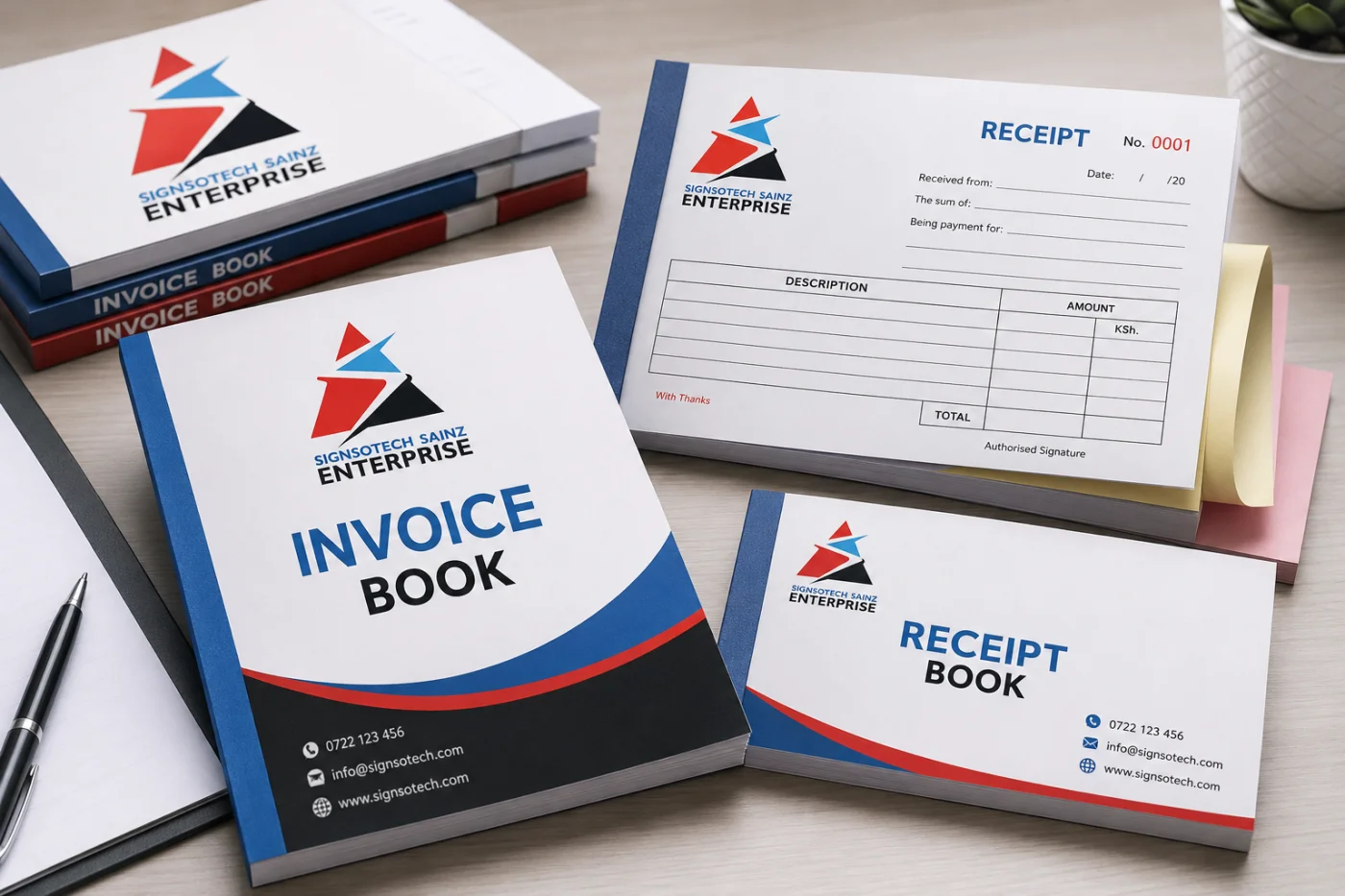


Need Print That Works as Hard as You Do?
Business cards, brochures, receipt books and more — premium print with fast turnaround from Mecca House, Nairobi CBD.
Chat on WhatsApp
Join the Conversation