
Hotel and Restaurant Print: A Checklist From the Gate to Checkout

Walk with a guest from the gate to checkout and count the printed things they touch: the sign at the entrance, the registration card, the key tag, the door card, the menu, the bill folder, the coaster under their drink. Each one is small, and together they tell the guest how carefully the place is run. Each one also has a practical job to do, many times a day.
The short answer
Order hospitality print as one family, in one design, so every piece matches. Choose materials for handling, not looks: PVC where things get wet, laminate where they are passed across a desk all day. Build in the details that save staff time, such as a wifi code on the back of the key tag and replaceable menu inserts.
Key takeaways
- Order the whole family together so colours and finishes match from arrival to checkout.
- Print the back of every tag and card: wifi, checkout time and reception number answer questions before they are asked.
- Menus with insert sleeves let you change one sheet when a price moves, not the whole cover.
- Registration cards collect personal data, so they should say what it is for.
The checklist, in the order a guest meets it
| Piece | What it must survive | The detail that pays off | From |
|---|---|---|---|
| Room and key tags | Handled at the desk all day, lost in pockets | Unique serial on every tag; wifi and checkout time on the back | KSh 35, min 1,000 |
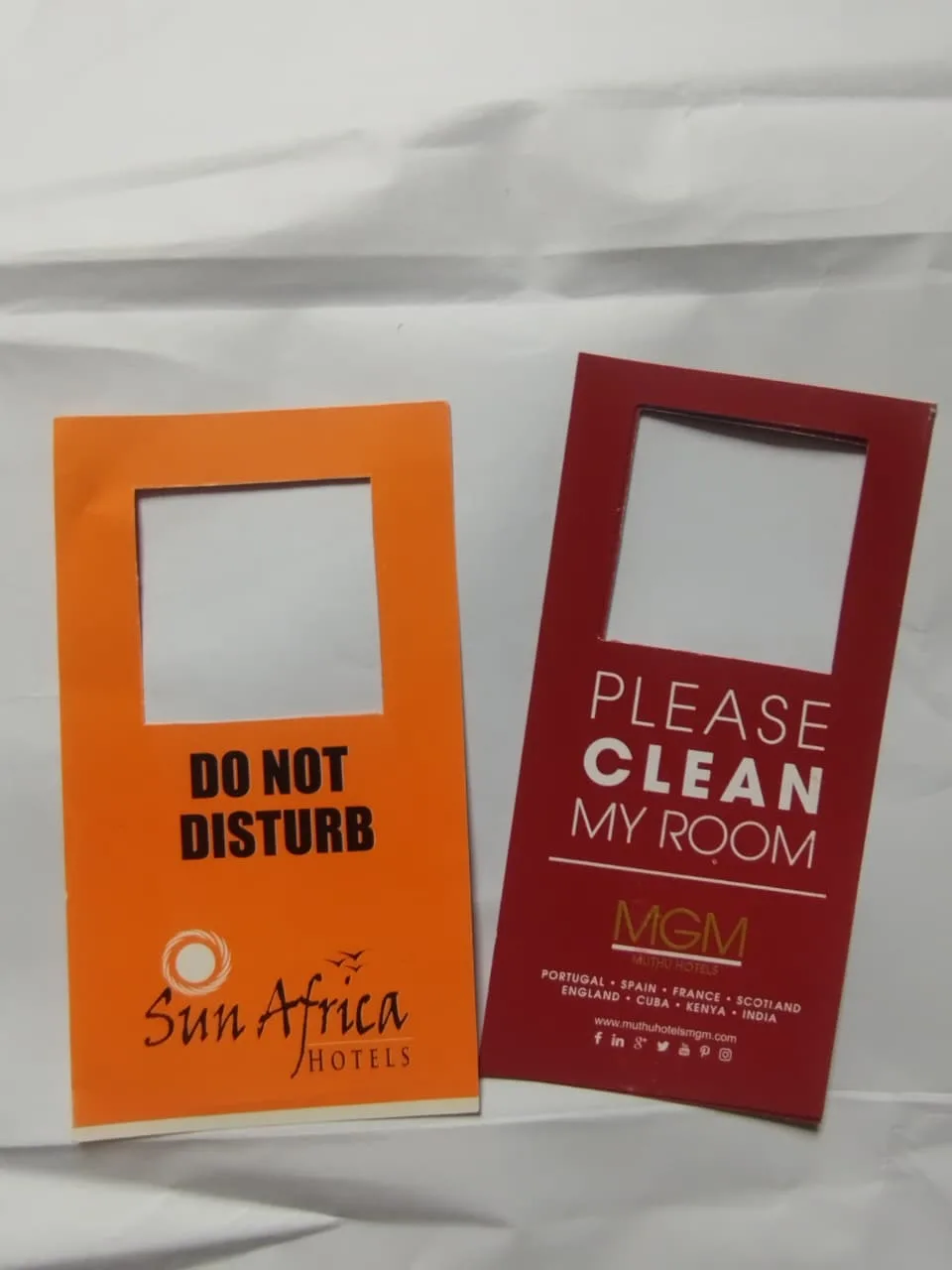
| Door cards | Hung and removed daily by guests and housekeeping | "Do Not Disturb" one side, "Please Service Room" on the other | KSh 75, min 500 |
| Menus and bill folders | Every guest, every meal, spills included | Insert sleeves for prices; a pen loop on the bill folder | KSh 2,500, min 10 |
| Coasters | Wet glasses and hot cups | Logo plus one useful line, such as the bar's opening hours | KSh 20, min 1,000 |
| Luggage tags | Rough handling at airports and bus stages | A slide-in window or flap for the guest's details | KSh 30, min 1,000 |
Key tags that run the front desk
A room tag looks like a small thing, but it runs a process. Every tag needs its own number with no duplicates, it is handed across a desk several times a day, and one will leave in a guest's pocket sooner or later. We print each tag in a run with its own serial, and duplicate-half tags (the guest keeps one half, reception files the other) are printed as one perforated piece, so the halves cannot be mixed up.
Where tags get wet, at the poolside, on a boat or at a lodge, use PVC. Elsewhere, heavyweight board with a laminate is enough. Print both sides of your room and key tags: the reverse can carry the reception number, the wifi code or the checkout time, which saves the front desk the same question many times a week.
The costly mistake Printing the room number together with the hotel's full name and address on the same tag. If the tag is lost, whoever finds it knows exactly which door it opens. Keep the room number on the tag and the address off it, or use a coded number that only reception can match.
Menus and bill folders
A menu is the most-handled piece of branding a restaurant owns, and the first to show wear. Covers in stitched leather or PU, with your mark in foil or blind deboss, last for years. The detail that saves money is the insert system: menu covers with clear sleeves or corner tabs mean that when a supplier's price moves, you print one sheet rather than replace the cover. Order all covers in one batch so the leather comes from one run and matches across the floor, the same principle as keeping printed colour consistent, which we cover in why printed colours look different from your screen.
Door cards and the registration card
Double-sided door cards in rigid PVC or laminated card survive daily housekeeping. Die-cut the slot to fit your actual door handles or keycard locks; a card that falls off the handle is a card that does not work.
The registration card is different, because it collects personal data. Under section 29 of Kenya's Data Protection Act, a business must, before collecting personal data and in so far as practicable, tell the person that data is being collected, what it is for and how to contact the business, among other things. A short printed notice on the card is the simplest way to do this. Ask your data protection adviser for the wording, and we will set it neatly on the card.
- List every piece a guest touches, from the gate sign to the luggage tag.
- Agree one design with the same logo, colours and type across all of them.
- Choose materials by handling: PVC for wet areas, laminate for desk use, leather for menus.
- Write the useful back side for each tag and card.
- Order together, so finishes and colours come from the same runs.
The gate sign is the first piece of the set. How a sign shapes a guest's trust before they walk in is in how great signage builds customer trust.
Frequently Asked Questions
Start with what guests touch most. A list of today's printed pieces and photos of the worn ones show which to replace first, and how to make the set match.
Sources: Data Protection Act, 2019, Kenya Law, section 29 (read 14 October 2026). This is practical guidance, not legal advice. Prices and minimums are Signsotech's published starting prices, October 2026.
Products in This Guide


Continue Reading

Comments are temporarily unavailable. Please check back soon.
Ready to Build a Brand Customers Remember?
Branded apparel, tags and corporate identity done right. Talk to our team and get a quote in minutes.
Chat on WhatsApp
Join the Conversation