
What to Put on a Staff ID Card, and What to Leave Off

A staff ID card is worn on a lanyard all day: on the matatu, in the bank queue, across the reception desk. Everything on it is public. So the design is two questions at once: security and privacy. The card has to prove who the holder is at a glance, and give a stranger who photographs it as little as possible.
The short answer
Print the photo, name, role or department, the organisation's name and logo, a staff or serial number, and an expiry date. Leave off national ID numbers, dates of birth, home addresses and personal phone numbers. Kenya's Data Protection Act requires personal data to be limited to what is necessary for the purpose.
Key takeaways
- Enough to verify, nothing more: photo, name, role, organisation, serial number and expiry.
- Keep personal details off the face: a serial number or QR code links to your own records instead.
- An expiry date keeps cards accurate, which the law also asks for.
- Print on PVC, not laminated paper: laminated inserts can be peeled apart and remade.
What belongs on the card
- A clear, recent photo taken against a plain background, large enough to compare with a face.
- Name and role or department, so a visitor knows who they are dealing with.
- The organisation's name, logo or crest, printed in a way that is hard to copy.
- A unique serial or staff number that matches your register.
- An expiry date, so old cards stop working when contracts end.
- A return line on the back: "If found, please return to" and the organisation's office number.
What to leave off, and why
Section 25 of Kenya's Data Protection Act requires every data controller to keep personal data adequate, relevant and limited to what is necessary for the purpose, and accurate and up to date where necessary. An ID card has one purpose. It identifies the holder at work. A national ID number, a date of birth or a home address does nothing for that purpose, and on a card worn in public it hands a stranger exactly the details used for identity fraud.
| Detail | Where it belongs | Why |
|---|---|---|
| Photo, name, role | On the card | Needed to identify the holder |
| Staff or serial number | On the card | Links the card to your register without exposing personal data |
| National ID number | In your HR records | Not needed to identify someone at work; valuable to fraudsters |
| Date of birth, home address | In your HR records | Personal, and nothing to do with the card's purpose |
| Blood group or medical note | Only if the holder agrees and the role needs it | Sensitive; decide case by case with the holder |
The costly mistake Copying the old card template that printed national ID numbers, because "that is how it has always been done". Each one is a data leak on a lanyard. Replace the ID number with a staff number, and keep the link between the two in your own records.
Making cards that last and are hard to fake
We print staff and membership ID cards directly onto 0.76 mm PVC, the same thickness as a bank card, rather than laminating a paper insert. Laminated paper peels apart on a lanyard. Worse, anyone with a laminator can open one, swap the photo and seal it again, while a printed PVC card stays rigid, waterproof and true to colour for years of daily wear.
- Send a spreadsheet and a folder of photos named to your staff numbers.
- Approve a proof sheet of the whole batch before anything prints. Check spellings and photo matches here.
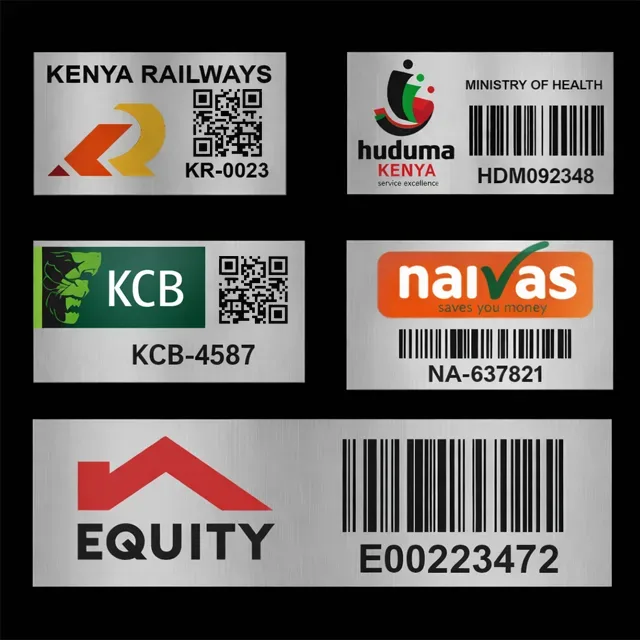
- Add a scannable code if you have a register: each card can carry its own barcode or QR code, printed variable. For codes on other items, see our barcode and QR labels and how barcodes are issued and printed.
- Choose holders and lanyards printed to match, or retractable clips for staff who swipe often.
Identification beyond the card In clinics, labs and workshops, a branded uniform does part of the ID card's job from across the room. Our branded dustcoats carry the organisation's mark where a card can be hidden under a sleeve. The same privacy thinking applies to guests: see the registration card notes in the hotel and restaurant print checklist.
Frequently Asked Questions
Is your current card giving too much away? Share one, with a sample row of the staff list, and see what stays on the card, what moves into your records, and how the new design looks.
Sources: Data Protection Act, 2019, Kenya Law, section 25 (read 14 October 2026). This is practical guidance, not legal advice. Prices are Signsotech's published starting prices, October 2026.
Products in This Guide


Continue Reading

Comments are temporarily unavailable. Please check back soon.
Ready to Print Your Compliance Labels?
We print millions of KEBS UCR labels and custom product stickers at Mecca House, Nairobi CBD. Bulk discounts apply.
Chat on WhatsApp
Join the Conversation