
How to Get a Barcode for Your Product in Kenya, Step by Step

The supermarket buyer likes your product, then asks one question: "What is the barcode?" If you do not have an answer, the conversation stops there. Getting one is a short, fixed process. Most people get one part wrong: they think the printer supplies the number. It does not. We print barcodes, but the number itself has to come from GS1, the body that licenses them worldwide.
The short answer
Apply to GS1 Kenya, the GS1 member organisation for the country. They license your company a GS1 Company Prefix. From that prefix you give every product variant its own number, then a printer turns each number into a barcode on your label and you test it on a real scanner before the full run.
Key takeaways
- The number comes from GS1, the printing comes from us. Nobody can print a valid retail barcode before you have the number.
- Every variant needs its own number: a 500 ml and a 1 litre bottle of the same juice are two products to a till.
- A barcode that scans on a flat proof can fail on a curved bottle, so test on the real pack.
- The barcode is not the KEBS UCR sticker. They do different jobs, and many products need both.
Where the number comes from
GS1 runs the numbering behind every supermarket till. Its guidance is short. Need a number? Contact a GS1 member organisation, which explains how to join and gives you a GS1 Company Prefix. You then allocate a unique number to each product from the range that prefix gives you.
In Kenya that organisation is GS1 Kenya. Ask them for the current application form, the fees and how many numbers your prefix should cover. A business with three products and one planning thirty will need different capacity, so count your range, including the sizes and flavours you plan to launch next year.
The costly mistake Printing 5,000 labels with a barcode number copied from somewhere else, or made up "just for now". A number that is not licensed to your company points to someone else, or to nothing. Check where every number came from before it goes on a label, and ask the buyer what they accept if you are unsure.
From number to a label that scans
- Register with GS1 Kenya and receive your GS1 Company Prefix.
- Make a product list. One line per variant: name, size, flavour or colour, and the number you are allocating it. This list becomes your master record, and it stops the same number going on two products.
- Send us the numbers, not images of barcodes. We generate each barcode from the number so the bars are exact, rather than scanning or stretching an old picture of one.
- Approve a proof with the barcode at its real size, in a dark colour on a light background. Red bars, or bars on a metallic or patterned background, are a common reason a code will not scan.
- Test on the actual pack. Stick a sample label on the real bottle, jar or pouch and scan it with a handheld scanner before the full run is printed.
Barcode, UCR sticker and label: three different jobs
| Item | What it does | Who issues it |
|---|---|---|
| Retail barcode | Identifies the product at the till and in stock systems | The number from GS1; printed on your label |
| KEBS UCR sticker | Shows the consignment has been through KEBS compliance | The reference comes through KEBS; printed to its specification |
| Product label | Name, ingredients, net content, batch, dates, manufacturer | You, following the rules for your product category |
The KEBS side is a separate subject with its own pitfalls, covered in KEBS UCR barcodes explained. We print UCR KEBS labels in bulk runs, and the barcode can usually sit on the same product label rather than a separate sticker.
Printing that holds up on the shelf
A barcode only has to fail once at a busy till for a buyer to remember it. Three things protect it. First, keep a clear margin of empty space either side of the bars, because scanners need it. Do not shrink the barcode to fit a crowded label. And choose a label material that survives the chill chain if the product goes into a fridge, since a smudged or lifted label will not scan.
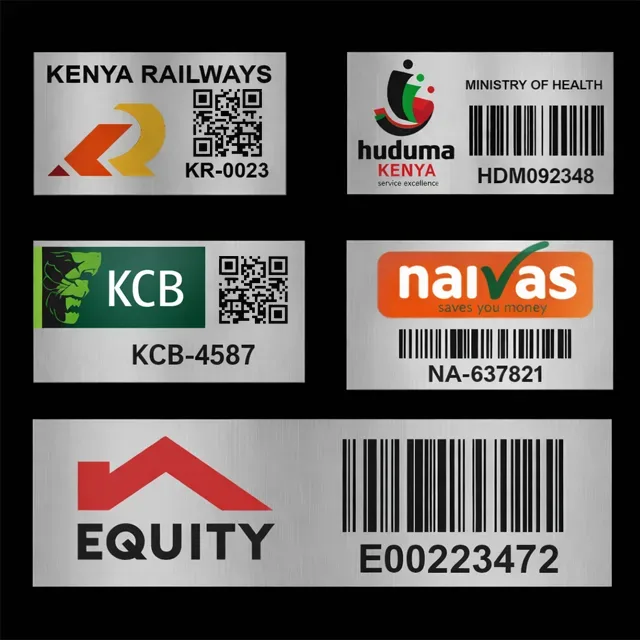
When you only need internal codes Barcodes for your own stock rooms, assets or batches do not need GS1 numbers. Our barcode and QR code labels start from KSh 2 a piece for that kind of run. Retail products sold through supermarkets are the case that needs GS1.
Label faults get stock rejected. The full list is in why some products get rejected by supermarkets.
Frequently Asked Questions
Got your numbers? A list and a photo of the pack are all it takes for a label laid out so the barcode scans first time.
Sources: GS1, "My company needs to barcode products. What do I need to do?" and GS1 Kenya (both read 14 October 2026). Label prices are Signsotech's published starting prices, October 2026.
Products in This Guide

Continue Reading


Comments are temporarily unavailable. Please check back soon.
Ready to Print Your Compliance Labels?
We print millions of KEBS UCR labels and custom product stickers at Mecca House, Nairobi CBD. Bulk discounts apply.
Chat on WhatsApp
Join the Conversation